How Often to Change Aquarium Water
Published October 6, 2026. Built by Jeremy Panasuk.
Open the calculator and use your own weekly tests. Stocking still comes first: a tank past its points makes nitrate climb faster. The 20-gallon walkthrough is how many fish in a 20 gallon tank. The starter order is how to keep pet fish alive.
What the manuals actually time
The Merck Veterinary Manual's management chapter includes water changes in the treatment of new tank syndrome, along with less feeding, chloride for nitrite toxicity, and a look at the biofilter. It does not attach a home-aquarium percent to that sentence. New tank syndrome usually occurs within the first 6 weeks. A tropical biofilter can take up to 8 weeks to establish. Those two clocks stay separate, and they are not a water-change calendar. The longer account of the cloud, and of those clocks, is how to fix cloudy water in a new tank.
The environmental-diseases chapter is specific once un-ionized ammonia is already high. If possible, change at least 50% of the water as soon as high un-ionized ammonia is detected. Check whether the source water itself contains ammonia or chloramines, because a change can add ammonia directly or release it when chloramine is dechlorinated. If total ammonia nitrogen is extremely high (above 5 mg/L) and pH is acidic (under 7), move the fish to a clean system already tempered for pH and temperature, so the rise in pH does not suddenly convert ammonium to un-ionized ammonia. Feeding should be discontinued or substantially reduced until the problem is corrected. That 50% line is an emergency response to high un-ionized ammonia. It is not a standing weekly hobby rule.
Old tank syndrome, in the management chapter, is a different failure. It is tied to small, infrequent water changes, or to topping off evaporated water with no exchange, often in tanks with large carnivorous fish. Total ammonia can be high but non-toxic because pH is low. If the fish are still alive, return the water toward normal with daily small water changes, to avoid pH shock and the ammonia toxicosis that can occur as pH rises. After that, use regular large water changes. One large change into an old, acidic, high-ammonia tank is the opposite of that instruction.
Worked examples on the water-change tab
The function solves for a change that holds the steady plateau at the ceiling you type. Fraction = rise / (ceiling − tap). If that fraction is 0.95 or more, it returns no schedule: tap nitrate is too close to the ceiling for water changes alone. Otherwise it rounds the fraction up to a 5% step, and it will not print a change under 15%. Plateau at the printed percent is round(tap + rise / (percent / 100)). The two runs below are example inputs, not readings.
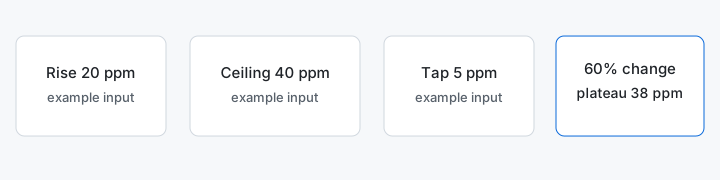
20 / (40 − 5) = 20/35. Rounded up to a 5% step, ceil((20/35) × 20) × 5 = 60. The plateau at a 60% change is round(5 + 20 / 0.60) = 38. Enter 20, 40, and 5 on the water-change tab if you want to see the same card. Do not reuse them as if they were measured in your tank. If your rise, ceiling, or tap is different, the percent is different.
10 / (40 − 0) = 0.25. ceil(0.25 × 20) × 5 = 25. The plateau is round(0 + 10 / 0.25) = 40, which is the ceiling you asked to hold. A smaller weekly rise, and tap nitrate at zero, is a smaller change. That is the whole point of testing instead of copying a percent from another tank.
Feeding is what pushes the rise around. UF/IFAS VM114 says one feeding a day is plenty for most pet animals, and that the most common mistake is over-feeding. The gram side of that sheet needs a body weight this site does not invent. See how much to feed tropical fish.
A common mistake
Treating every dirty tank as a candidate for one large change. In old tank syndrome the management chapter wants daily small changes first, while the fish are still alive, because a sudden pH rise can turn a high but non-toxic ammonia reading into toxic un-ionized ammonia. The emergency 50% line in the environmental chapter applies when high un-ionized ammonia is already detected, and only after you have checked the source water. Those are two different situations. A single weekly percent does not cover both.
Limits, and when to call a veterinarian
This page does not state a universal weekly percent, because the freshwater sources used here do not state one. Marine and pond chemical rates are a different system and are not copied onto a freshwater community tank. If fish are lethargic, off food, spinning, or dying, the water test comes before any treatment plan: how to treat sick fish, then an aquatic veterinarian. The calculator's stocking result still matters. An overstocked tank is one reason nitrate rises faster than the schedule you planned. Counts for 10, 29, and 55 gallons are on how many fish in a 10, 29, or 55 gallon tank.
Shop an aquarium liquid test kit on Amazon
Affiliate Affiliate disclosure: as an Amazon Associate, we earn from qualifying purchases — at no cost to you. A liquid test kit is listed because the percent depends on a measured nitrate rise, and the manuals require an ammonia test before a large emergency change. This site has not reviewed a brand.
Compiled with AI assistance from the sources below. Spot an error? Email jpanasuk@gmail.com.
Sources
- Petty BD, Francis-Floyd R, Yanong RPE. Management of Aquarium Fish. Merck Veterinary Manual. Full review May 2022. Last updated June 2026. https://www.merckvetmanual.com/exotic-and-laboratory-animals/aquarium-fish/management-of-aquarium-fish. Accessed October 6, 2026.
- Francis-Floyd R, Yanong RPE, Petty BD. Environmental Diseases of Aquatic Animals in Aquatic Systems. Merck Veterinary Manual. Full review May 2023. Last updated June 2026. https://www.merckvetmanual.com/exotic-and-laboratory-animals/aquatic-systems/environmental-diseases-of-aquatic-animals-in-aquatic-systems. Accessed October 6, 2026.
- Francis-Floyd R. Fish Nutrition. VM114. University of Florida IFAS. Original publication March 2002. Reviewed October 2011. https://extension.rwfm.tamu.edu/wp-content/uploads/sites/8/2013/09/Fish-Nutrition.pdf. Accessed October 6, 2026. Cited for feeding frequency, not for a water-change percent.
- The 60% / 38 ppm and 25% / 40 ppm results are this site's water-change function on the example inputs written above. They are not a measured tank and not a published weekly standard.